
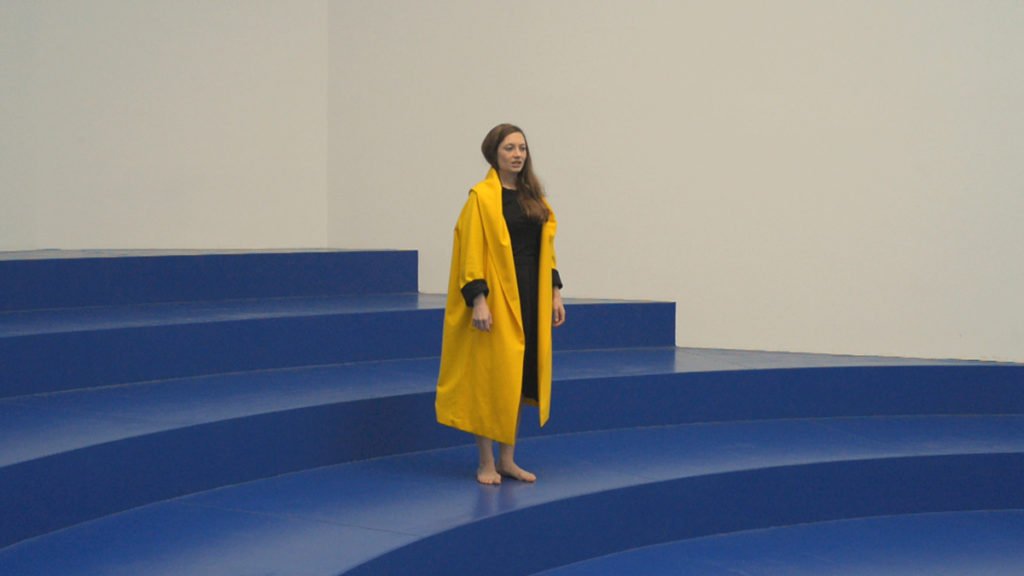
Ariane Loze
wpZimmer resident in 2020
Since 2008 Ariane Loze researches the coming to life of a story out of seemingly unrelated images with her camera. In these series of videos she takes on all the parts: she is at the same time the actress, the camerawoman and the director. Through the editing of the images she develops a relation between two (or more) characters and the architecture. The videos of Ariane Loze put the spectator in the active role of creating his/her own story out of the basic principles of film editing: shot and counter-shot, the presumed continuity of movement, and the psychological suggestion of a narrative. The filming of these videos has been made public as an ongoing performance.
Ariane Loze studied theatre direction at the RITCS Brussels, and took part in a.pass (Advanced Performance And Scenography Studies) in Antwerp. She is laureate of the HISK (Higher Institute for Fine Arts) Ghent 2016-17.
The videos of Ariane Loze will be presented at the Salon de Montrouge Paris (May 2018) and in the new museum for contemporary art KANAL Centre Pompidou in Brussels (May 2018).
Recent exhibition projects include Videoformes Clermont-Ferrand (2015), Traverse Vidéo Toulouse FRAC Midi-Pyrénées (2015), Medienwerkstatt Berlin (2016), S.M.A.K. Etcetera Ghent (2016), Boghossian Fondation Brussels (2016), De Appel “You are such a curator” Amsterdam (2016), “Kunst om de lijf” Emergent Veurne, New York Anthology Film Archive AXW screening (2017), Watch this Space Biennale #9 Lille Brussels (2017), Gemischte Gefühle Tempelhof Berlin (2017).
Ariane Loze’s videos got selected for the Movimenta Video Art prize in Nice (2017), and the Prix Médiatine Brussels (2016) and got awarded at the Art Contest Brussels (2015), by the Art For All Society of Macau (2016) and Côté Court Festival Pantin (2017).
projects
 Business Happiness
 Business Happiness
 We talk and, in fact, we are talked about. It is the times that speak; its ideology permeates our words and influences our lives. We believe we act and are acted upon. By bringing together in an impressionistic way samples of words from the world of work and its organisation, Ariane Loze creates a show whose strangeness surprises.

© Mathilde Delahaye
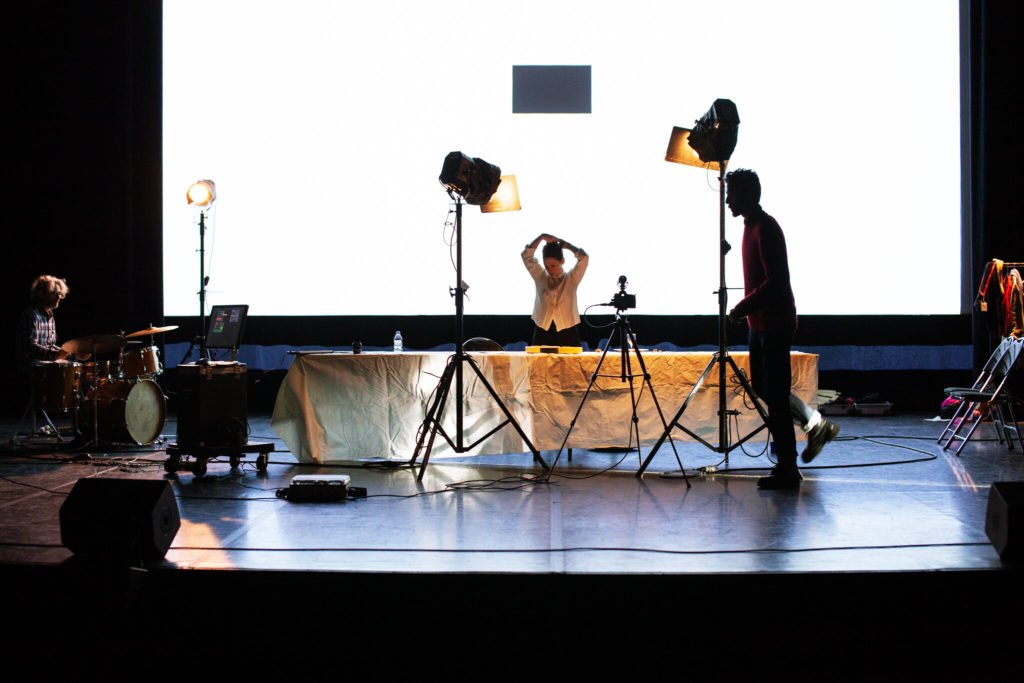
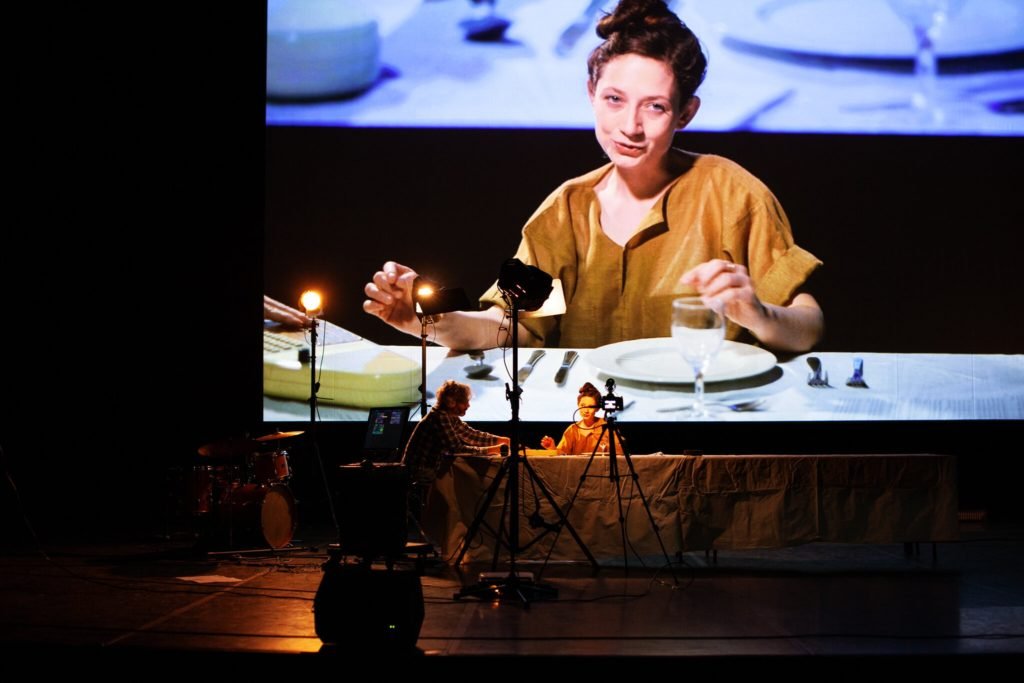
The first sentences could make us think of bits of conversations glanced at during a cocktail party, we recognize the contemporary all-entrepreneurship mixed with an ideology of ideal management. Behind these dialogues is a reflection on work, its constraints and the space of freedom that everyone is looking for within the framework that he creates or undergoes. And what about the people who work? Do they talk about work or activity, passion or flexible hours?
Ariane Loze observes, with a precise and profoundly benevolent eye, the world in which we live and reports on it through her voice, her gestures, her body, letting herself be crossed by the words of each and everyone.
As a guest on the set of a film in creation, the spectator discovers different characters coming to life on the stage, being at the same time a film studio. Ariane Loze, playing alternately the different characters in attendance, takes the spectator into a fragmented time, like the rushes of a film.
The play, Business Happiness, also testifies to our relationship with time. How much time do we dedicate to work? How do we envisage the time that remains once a working day is over?
In the 1970s, Ivan Illich, a thinker of political ecology, announced in a precise and impressive way the state of mind of the society in which we live today: “The exchange value of time is taking back the first place, as language shows. We are talking about time spent, saved, invested, wasted, put to good use. Society attaches a price tag to each person that indicates his or her hourly value. The faster we go, the wider the price gap becomes. There is an inverse correlation between equality of opportunity and speed.” Ivan Illich, Energy and Equity, Ed. Seuil, 1975.
Are we capable of living at full speed and feeling sensations the same way? How is our self-awareness evolving in the face of this ambition for complete control of our lives, when chance and the vagaries of life often make it the flavour?
credits